Africa's Story.
Told With Responsibility.
Our publications exist to inform decision-makers, elevate African voices, and document the realities shaping business, industry, and society across the continent.

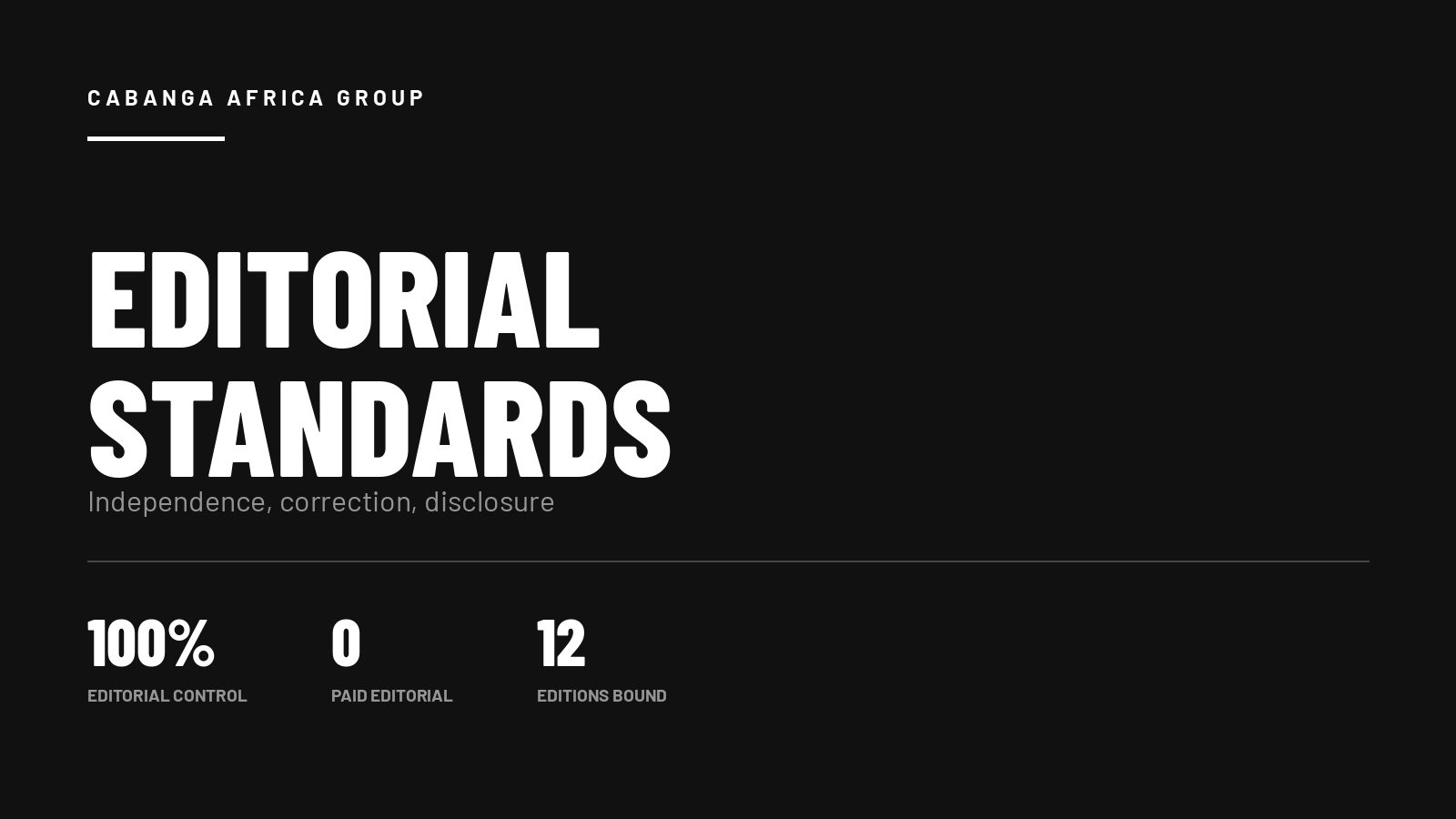
Cabanga Africa Group sells advertising separately from editorial. Paid space carries no influence over coverage in any of the twelve editions.
- Advertising and editorial are decided by separate desks.
- Anything resembling editorial in layout is labelled ADVERTISEMENT.
- Sponsored features are produced by the editorial desk and always labelled.
- Corrections are published rather than quietly edited.
Our Editorial Mandate
Cabanga Africa Group publications are built on a simple belief: Africa must think for itself, tell its own stories, and define its own economic future.
Our editorial work focuses on the Real Economy - the businesses, entrepreneurs, institutions, and industries actively building Africa.
- Strengthens economic understanding
- Encourages informed leadership
- Promotes responsible entrepreneurship
- Supports continental collaboration
- Elevates credible African expertise
To Think. To Understand. To Lead.
How We Work
Accuracy
Information is verified through credible sources before publication.
Fair Representation
Stories present balanced perspectives while respecting cultural, regional, and professional diversity.
Responsibility
Content avoids misinformation, sensationalism, discrimination, or harmful narratives.
Relevance
We prioritise material contributing meaningfully to African business, leadership, innovation, and development conversations.
Independence & Ethics
Editorial decisions are guided by professional standards, public interest, and factual accuracy - independent of political influence, commercial pressure, or external agendas. Advertising partnerships do not determine editorial conclusions.
For editorial enquiries, corrections, or contributor submissions: editorial@cabanga.africa
The Five-Beat Spine
Every Cabanga piece moves through the same five beats — flexible in execution, reliable in shape. A reader should be able to enter any title in the network and feel the same structure underneath. The spine is the essence made operational: to think, to understand, to lead, rendered as an article.
The position
An opening that states what is happening and why it matters, in the first two sentences. No scene-setting and no throat-clearing before the point.
The ground
The situation set quickly and accurately — the market, the numbers, the players, the regulation. This is where the reporting shows.
The mechanism
How the thing actually works: the value chain, the capital flow, the incentive, the constraint. This beat is what separates Cabanga from commentary.
The consequence
What follows for the reader’s business — the second-order effect most coverage stops short of.
The decisive close
The move that matters. A named implication or recommendation, not a summary. The piece ends by pointing at an action.
Beat 03 is non-negotiable
A piece that describes an event without explaining the mechanism underneath it is a news item, and the network does not publish news items. If the writer cannot explain how it works, the piece is not ready.
The Four Questions
Every piece must answer at least one of these. A piece that answers none is coverage. A piece that answers one is intelligence.
How does this actually work?
What is the mechanism, the value chain, the flow of capital or goods underneath the story?
What does a business do differently now?
What decision changes — pricing, hiring, market entry, financing, procurement — because of this?
What pattern is hiding in plain sight?
What is happening across markets or sectors that nobody has yet named as a single thing?
Why does this matter beyond one border?
What is the continental read — how does this event in one market change the calculation in another?
Conditions of Publication
The fixed checklist. Every piece clears all of it before it is scheduled — no exceptions for deadline, no exceptions for seniority, no exceptions for a commercial relationship.
- The five-beat spine is present, and beat 03 explains a real mechanism.
- Every factual claim is sourced to a document, a named person, a filing or a dataset. Unverifiable claims are cut, not hedged.
- At least one named, on-the-record voice from inside the market being covered. Analyst commentary alone is not reporting.
- Figures carry their units, period and source.
- The right of reply has been offered where a piece is critical of a named party, and the offer is recorded.
- A decisive close — the piece ends on an implication, not a recap.
- Mandatory metadata: title, meta description, keywords, section, region tag, sector tag.
- An image and a written caption that adds information rather than repeating the headline.
- No unlabelled commercial content. Sponsored, partner and advertorial pieces carry their label at the top, in the reader’s line of sight.
- Editor sign-off recorded against the assigned editor for that title.
Errors are corrected in public — a dated correction note appended to the piece, stating what was wrong and what is now right. Silent edits are a breach. A network that corrects visibly is trusted more, not less.
The Headline Standard
A Cabanga headline says what a story means, not merely who it is about. It carries a position, a mechanism or a consequence — never a label.
Headlines That Work
- Name the mechanism
- Name the consequence
- Name the position
- Carry a number that means something
Under 12 words for a standard piece. A headline that needs a subordinate clause needs a standfirst instead. The standfirst carries the second idea in one sentence of 20–30 words.
Headlines That Fail
- Announcement headlines
- Label headlines
- Curiosity gaps
- Vague abstractions
- Adjective stacking
Sentence case in body listings, uppercase in display setting. The typographic system handles the shouting; the words do not.
Editorial Questions
What is the Cabanga five-beat spine?
Every Cabanga piece moves through the same five beats: the position, the ground, the mechanism, the consequence and the decisive close. Beat three is non-negotiable - a piece that describes an event without explaining the mechanism underneath it is a news item, and the network does not publish news items.
Does advertising influence Cabanga editorial coverage?
No. Advertising never determines conclusions. Sponsored and partner content is labelled unambiguously at the top, editorial teams are briefed on the subject and never on the verdict, and a client of the commercial divisions receives no editorial preference. Commercial staff may request coverage; only editors decide it.
How does Cabanga handle corrections?
Errors are corrected in public. A dated correction note is appended to the piece stating what was wrong and what is now right. Silent edits are a breach of the standard.
How do I submit a story or a correction?
Email editorial@cabanga.africa with the title concerned, the piece and the specific claim in question. Contributor submissions go to the same address.
What Is Separated From What
| Question | Position |
|---|---|
| Does buying space influence coverage? | No. Space carries no influence over editorial coverage. |
| Is coverage offered with a booking? | No. Coverage is never offered, implied or withheld in connection with a booking. |
| How is advertising that looks editorial handled? | Labelled ADVERTISEMENT at the head of the space, in the house style. |
| Who produces sponsored features? | The editorial desk, to the house standard. Always labelled, quoted separately. |
| Can an advertisement be declined? | Yes. The publisher may decline without stating a reason and refunds in full. |
| How are errors handled? | Corrections are published rather than quietly edited. |
How A Correction Is Handled
- The error is logged the moment it is raised, whether it comes from a reader, a source or the desk itself.
- The editor of the edition verifies it against the original material. Nothing is corrected on assertion alone.
- If the error is confirmed, the correction is published in the next edition and applied to the digital record.
- The correction states what was wrong and what is right. It does not bury the change or reword the original silently.
- Corrections are never traded. No advertiser, sponsor or subject can obtain, prevent or amend one.
Published by Cabanga Africa Group. Reviewed by Oscar Manduku-Habeenzu, MBA, Founder and Expansion Architect. Last reviewed .